
Sales to Consumers in the EU
OSS may apply to certain cross-border B2C supplies within the European Union, allowing the related VAT to be declared through a one-stop-shop scheme.
SERVICE
DESLIN supports e-commerce businesses with OSS and IOSS — from assessing which scheme may apply and assisting with registration to VAT reporting and ongoing compliance for cross-border sales.
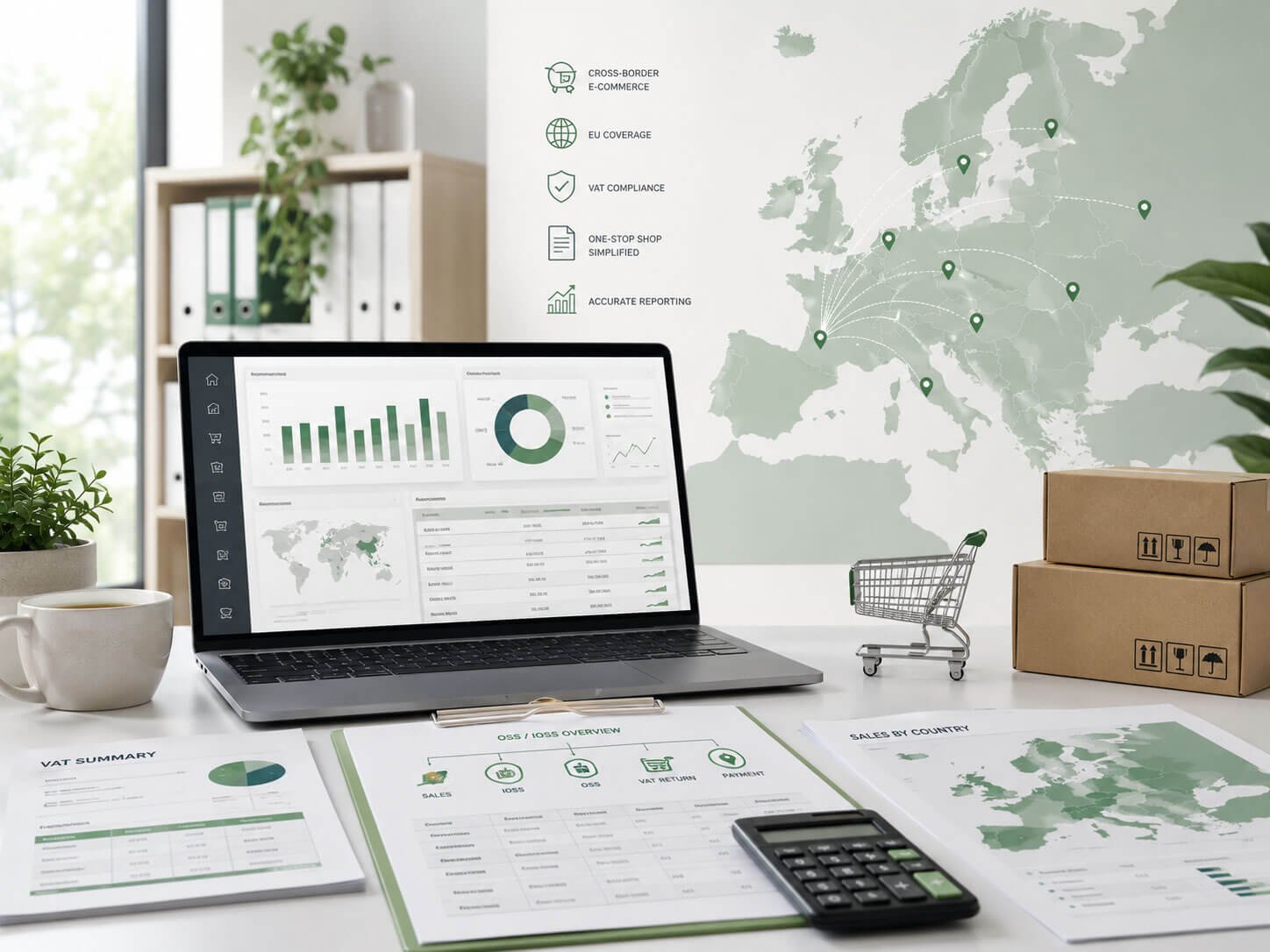
Selling to consumers in different countries can create specific VAT requirements for an e-commerce business. OSS (One Stop Shop) and IOSS (Import One Stop Shop) are special schemes designed to simplify the fulfilment of certain VAT obligations through a one-stop-shop system.
OSS and IOSS are not interchangeable. The appropriate scheme depends on what you sell, where the goods are dispatched from, where your customers are located and how your business model is organised.
DESLIN reviews each client's activities to determine whether OSS or IOSS may apply and what obligations arise in relation to registration, VAT calculation and ongoing reporting.
Our aim is to organise cross-border sales around a clear VAT framework, so that the growth of your e-commerce business in the European market is not hindered by gaps or inconsistencies in VAT reporting.
The appropriate scheme depends on the actual flow of goods or services and on where the final customer is located.
OSS may apply to certain cross-border B2C supplies within the European Union, allowing the related VAT to be declared through a one-stop-shop scheme.
IOSS relates to certain distance sales of goods imported from third countries or territories and supplied to consumers in the EU, where the conditions of the scheme are met.
Whether you sell through your own online store, a marketplace or another digital platform is relevant when assessing VAT obligations and the appropriate special scheme.
When a business sells to consumers in different markets, the country of consumption, applicable VAT treatment and the data required for correct reporting need to be tracked consistently.
DESLIN can assist both with the initial assessment and registration process and with the ongoing reporting of sales where the relevant scheme applies.
We review the business model, markets and types of sales to determine whether OSS or IOSS may apply and which scheme is relevant to the specific sales flows.
We assist in organising the registration process under the relevant special scheme according to the specific circumstances of the business.
We consider the applicable VAT treatment and the Member State of consumption when organising the calculation and reporting of VAT for eligible sales.
We assist with the preparation and filing of the applicable periodic returns under the relevant scheme.
We provide guidance on VAT reporting matters related to distance sales to consumers across the European market.
Where required, we assist with communication with the Bulgarian National Revenue Agency in relation to the application of the relevant schemes.
OSS/IOSS support begins with an analysis of the actual sales flows rather than automatically selecting a particular scheme.
We establish what you sell, where goods are dispatched from or services are supplied, where your customers are located and which sales channels you use.
We assess whether the specific supplies fall within the scope of OSS, IOSS or require a different VAT treatment.
We establish what information needs to be tracked so that sales and the related VAT can be reported consistently across the relevant countries and sales channels.
Following registration, we assist with the applicable returns and ongoing VAT matters relating to sales reported under the relevant scheme.
OSS and IOSS are different special VAT schemes. OSS can be used for certain cross-border supplies to consumers within the EU, while IOSS is designed for certain distance sales of goods imported from third countries or territories and supplied to consumers in the EU.
OSS and IOSS are special schemes designed to simplify the fulfilment of certain VAT obligations. Whether a particular scheme is applicable and appropriate should be assessed according to the types of sales, the countries involved and the way the business is organised.
OSS can reduce the need for separate VAT registrations for supplies that fall within the scope of the scheme, but it does not automatically replace every possible local VAT obligation. Holding stock in another country, making local supplies or carrying out other activities may require a separate assessment.
For sales covered by the relevant scheme, the Member State of consumption and the VAT treatment applicable to the particular transaction are important. The systems used by the online store therefore need to provide reliable sales data by country.
Yes. Different sales flows within the same e-commerce business may require different VAT treatment. For example, sales of goods that are already located within the EU and sales of goods imported from third countries should be considered separately according to the specific circumstances.
Yes. DESLIN works with businesses using Shopify, WooCommerce, Amazon, eBay, Etsy and other e-commerce systems, with the accounting and VAT support adapted to the characteristics of the particular business model.
Tell us how you sell, where your goods are dispatched from and which countries your customers are located in. We will analyse your business model and discuss whether OSS or IOSS may apply and how the related VAT reporting should be organised.